Fire-retardant paint for wood: how to navigate regulations and fire reaction classes

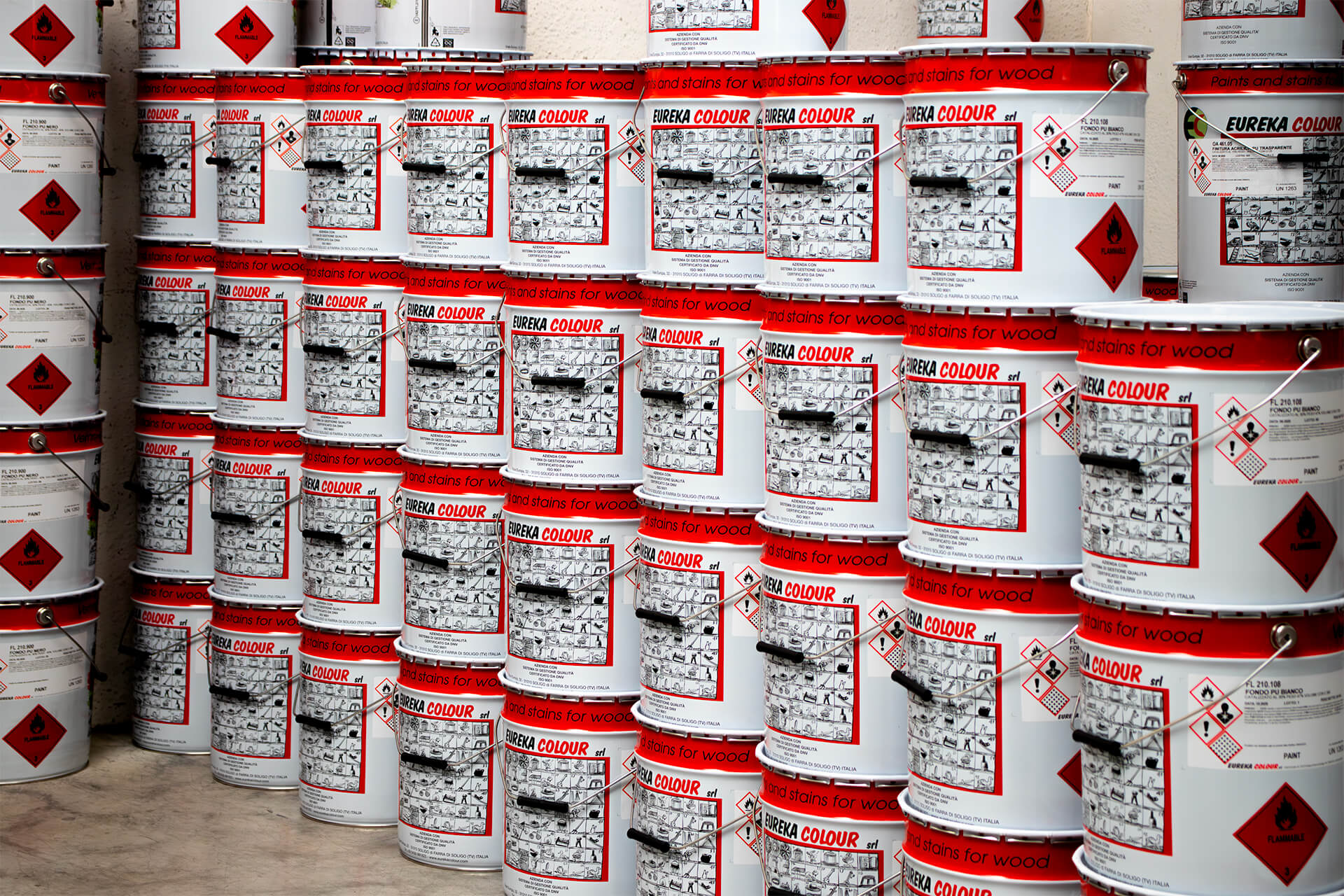
Storage of Eureka Colour fire-retardant paint buckets

What is meant by fire-retardant paint and why is it important?

When discussing fire-retardant paint for wood, the topic may seem complex. In reality, wood is, by its very nature, a combustible material. However, in many settings, both public and private, it is necessary to ensure high fire safety standards without compromising the aesthetic and structural qualities of wood. To meet these requirements, certified fire-retardant coating systems are used. These systems are developed and tested to slow down the spread of flames in the event of a fire. Fire resistance tests are carried out by certified laboratories and assess how the wooden product behaves under critical conditions. To choose the most suitable coating system, it is important to understand which certification is required and whether it applies to your specific project. The most common certifications refer to Italian and European regulations, which test products according to different technical standards and therefore assign different classifications.

Italian regulations and European regulations

Italian regulations are governed by Ministerial Decree (DM) 06/03/92 and use the technical standard UNI 9796 as an operational framework. This allows the coating product to be directly classified and to obtain ministerial approval.
The fire reaction class achieved by the paint is transferred to any type of wooden substrate used (with a few exceptions). Fire reaction classes assign materials a score ranging from 0 to 5. The best achievable result for a coated substrate is approval in Class 1. European regulations, on the other hand, are governed by the UNI EN 13501-1 standard, which defines standardised testing methods and classifies all construction materials. This system links the coating product to the type of wooden substrate used and its intended application. Fire reaction classes are labelled from A to F. For wall and ceiling applications, smoke production (s) and flaming droplets (d) are also assessed. For the “s” parameter, values range from s1 (low emission) to s3 (high emission). For the assessment of flaming droplets, values range from d0 (no droplets) to d2 (significant dripping). To indicate that the test has been carried out for floor applications, the suffix “fl” is added to the achieved class, and smoke production is also assessed.

Manufacturer responsibility and Eureka Colour solutions